Translate

Wednesday, November 27, 2013

Catholic Church and Mass Media

Catholic Church and Mass Media

By the Second Vatican Council in the 1960s, the Catholic Church was becoming quite enthusiastic about the opportunities afforded by the media. Documents used terms such as "marvelous technical inventions" (1963) and "gifts of God" (1971). This last quote was contained in a landmark document called Communio et Progressio ('Instruction on the means of social communication') by the Pontifical Council for Social Communication, founded by Pope Paul VI. It is directed both at those who work within the media and at recipients of messages through the media. The professionals are reminded that they have a responsibility to express the dignity of the human being and to serve truth in their productions and publications. The document also urges Christians to help "bring to the fore a Christian point of view on all questions that exercise people in society" (n. 103). 

The decree on Social Communication Inter Mirifica was one of the very first two documents promulgated by the Second Vatican Council on December 4, 1963. More than 40 years after the final promulgation by Pope Paul VI on December 4, 1963. One might see Inter Mirifica in a different light. One has to admit that the Council Fathers in their decision to reduce the document to its essentials but at the same time asking for a more extensive pastoral instruction to be worked out by professionals was a wise move. This pastoral instruction “with the help of experts from various countries” was published as Communio et Progressio on May 23, 1971 in order to “ensure that all the principles and rules of the Council on the means of Social Communication be put into effect” (Inter Mirifica, 23). This instruction which was endorsed and approved by Pope Paul VI therefore must be considered as integral and interpretative part of the Council Decree.

-The decree itself sees the use of the modern means of communication as being already included in the teachings of Jesus Christ to share the faith with all the world (Mt. 28, 18). From here the decree states that it is the birthright of the Church to use and own these means of communication for her pastoral activities. Such a stand has consequences for all pastors as well as lay members of the Church (IM, 3). From such a conviction flows the need to keep and develop the moral order within which the media are to operate and used according to the circumstances but also the conscience of those involved (IM, 4-5). The right to information as a moral right and part of human dignity is confirmed; art and moral law as well as the presentation of evil are addressed (IM, 6-7). The role of Public opinion is underlined, but also the responsibilities of recipients, communicators and civil authorities are mentioned (IM, 9-12).
In 2012, Pope Emeritus Benedict XVI surprised the world by joining Twitter. Behind the scenes, the Pontifical Council for Social Communications provided instrumental guidance for Church leadership in the use of new and popular mediums of communication, leading the Pope himself into this new and exciting platform for social communication. The Pontifical Council for Social Communications is the Vatican’s department for handling social communications, from newspaper to radio and from television to internet. This collection provides the official writings of this dicastery, laying a ground work for a Catholic understanding of social communication channels and guiding the decisions of the leadership of the Catholic Church in the use of new instruments of communication. Most importantly, the Pontifical Council for Social Communications explores new ways in which the gospel can be distributed through new and emerging social communication channels.

POPE FRANCIS


Pope Francis the great communicator of LOVE


Pope Francis: a new approach to communication


Almost a month on from the election of the first Latin American pontiff, the head of the Vatican’s Council for Social Communications says Pope Francis is pioneering new ways of sharing the faith with people in and outside the Christian Church.
At the heart of the discussion, Archbishop Celli says, lies not just the question of how to use the new technologies, but rather of how to bring the Word of Christ to men and women living in an increasingly digitalized world. Archbishop Celli says: “I will give you an example: do you remember how the Pope was embracing a young handicapped boy, placing his cheek near to the cheek of the boy? No words, but that was the only way to communicate something to that boy. I think this pope, Pope Francis, from Latin America, is helping us to rediscover that communication is not only an intellectual problem…..As you realize, he’s using images – last Holy Thursday he was addressing priests working here in Rome, telling them that a good priest must have the smell of the sheep to whom he is belonging – a quite clear image! With that image the Holy Father was communicating a lot of concepts that people can perceive immediately from that image. It means that Pope Francis is not only touching the intellectual aspect, but is touching the heart and the imagination – that is why I’m talking about a new approach to communication…”(Vatican Radio)
During his general audience, Pope Francis reflected on the resurrection of the body, explaining that we are “imprinted” with eternal life, which we are able to experience even now through the sacraments. “Through baptism, we are inserted into his death and resurrection and begin to experience new life,” the pope stated in his Dec. 4 general audience, highlighting how “the seed of eternity is planted within us.” Pope Francis directed his weekly address to the thousands of pilgrims present in Saint Peter’s Square, returning to the conclusion of the Creed when believers proclaim their belief in “the resurrection of the body.” “Dear brothers and sisters,” he began, “today we look again at the affirmation: “I believe in the resurrection of the body,” highlighting three different aspects of the relationship between Christ’s resurrection and our own. First of all, noted the pontiff, “the Gospel reveals to us that our faith in the resurrection is bound to the person of Jesus Christ, who himself said ‘I am the resurrection and the life.’”
This proclamation, the pope stated, “is not easy to understand” because we are “immersed in this world,” however “the Gospel clarifies it to us: the fact that Jesus resurrected is the proof that the resurrection of the dead exists.” In the Gospel, observed the pontiff, “the Risen Christ gives his disciples the Holy Spirit as a pledge of communion with God which has its fullness in eternity.” “The anticipation of eternal life is the source and reason for our hope. If this hope is cultivated,” he explained, “It illuminates our lives as persons and communities.”  “Like us in all things but sin, Christ gathers us to himself so that we may accompany him in his journey back to the Father,” the pope continued, stating that Jesus has “taken us with him on his return to the Father in the glorious kingdom.” “The omnipotence and faithfulness of God do not end at the door of death… Christ is always with us, he comes every day and he will come at the end.” Turning to the physical aspect of our resurrection from the dead, the pope explained that “Christ rose in his glorified body,” and that “through Christ, our bodies will also be glorified and reunited with our souls at the resurrection.”
“Living off of this faith,” he emphasized, “we will be less prisoners of the ephemeral, less prisoners of the transient,” going on to say that “this transfiguration of our body is already being prepared.” It is prepared for us in this life, he observed, “with the encounter of the Risen Christ, especially in the Eucharist, in which we nourish ourselves with his Body and Blood.” Pope Francis concluded by explaining that through our baptism, we have been “inserted” into the death and resurrection of Jesus “and begin to experience new life,” adding that “the image of eternity is imprinted on us and calls us to respect the lives of all people, especially those who suffer.” “In this way,” explained the pope, “we can experience the closeness of the Reign of God, towards which we all journey together.” “We have a seed of the resurrection, a glimpse of eternity, which always makes all human life worthy of respect and love.”
After his address, Pope Francis urged the 30,000 pilgrims in attendance to offer special prayers for a group of nuns who were taken by force from the Greek Orthodox Monastery of Saint Tecla in the ancient Christian town of Ma’lula in Syria earlier this week. “I would like to invite everyone to pray for the religious sisters,” he petitioned, according to a Catholic News Agency report, “who, two days ago, were taken away by force by armed men.” According to Vatican Radio, the 12 nuns, as well as three other women, were forced to “evacuate” their convent in Ma’lula on Monday, and were taken to the neighboring town of Yabroud, which has a large Christian population, and is also controlled by the rebels. “Let us pray for these sisters, and for all those who have been kidnapped on account of the on-going conflict,” the pope encouraged, “let us continue to pray and to work for peace.” The Holy Father brought the audience to a close by leading the faithful in praying a “Hail Mary,” and invoking the intercession of Mary “Queen of Peace.” (Vatican Radio)

Wednesday, October 30, 2013

List of Roman Catholic dioceses in Sri Lanka

List of Roman Catholic dioceses in Sri Lanka

The Roman Catholic Church in Sri Lanka is composed of one ecclesiastical province with an archdiocese and 11 suffrages dioceses.

·        Diocese of Anuradhapura
·        Diocese of Badulla
·        Diocese of Batticaloa
·        Diocese of Chilaw
·        Archdiocese of Colombo
·        Diocese of Galle
·        Diocese of Jaffna
·        Diocese of Kandy
·        Diocese of Kurunegala
·        Diocese of Mannar
·        Diocese of Ratnapura
·        Diocese of Trincomalee

 #
Catholics
Population
Percent Catholic
Diocese
Year
Source
1
648,184
5,522,956
11.74%
Colombo (Archdiocese)
2004
ap2005
2
231,205
679,113
34.05%
Chilaw
2004
ap2005
3
166,329
1,625,925
10.23%
Jaffna
2004
ap2005
4
75,435
2,414,973
3.12%
Kandy
2004
ap2005
5
73,977
219,633
33.68%
Mannar
2004
ap2005
6
62,078
1,514,336
4.10%
Trincomalee-Batticaloa
2004
ap2005
7
48,967
1,505,866
3.25%
Kurunegala
2004
ap2005
8
23,812
1,797,355
1.32%
Ratnapura
2004
ap2005
9
21,985
1,614,000
1.36%
Badulla
2004
ap2005
10
9,855
1,105,663
.89%
Anuradhapura
2004
ap2005
11
8,100
2,210,486
.37%
Galle
2004
ap2005

·         Note: The table above is generated with the most recent data available for each diocese.

Thanks to- www.catholic-hierarchy.org/country/dlk.htm

Beauty of Srilanka

Beauty of Srilanka


Sri Lanka (/sriːˈlɑːŋkə/, /sriːˈlæŋkə/ or Listen/ʃriː ˈlɑːŋkə/;Sinhala: ශ්‍රී ලංකාව, śrī laṃkāva, Tamil: இலங்கை, ilaṅkai), officially the Democratic Socialist Republic of Sri Lanka, is an island country in the northern Indian Ocean off the southern coast of the Indian subcontinent in South Asia; known until 1972 as Ceylon (/sɨˈlɒn/, /seɪˈlɒn/, or /siːˈlɒn/), Sri Lanka has maritime borders with India to the northwest and the Maldives to the southwest.
Sri Lanka has a documented history that spans over 3000 years. Its geographic location and deep harbours made it of great strategic importance from the time of the ancient Silk Road through to World War II. Sri Lanka is a diverse country, home to many religions, ethnicities and languages. It is the land of the Sinhalese, Sri Lankan Tamils, Moors, Indian Tamils, Burghers, Malays, Kaffirs and the aboriginal Vedda. Sri Lanka has a rich Buddhist heritage, and the first known Buddhist writings were composed on the island. The country's recent history has been marred by a thirty-year civil war which decisively but controversially ended in a military victory in 2009.
Sri Lanka is a republic and a unitary state governed by a presidential system. The capital, Sri Jayawardenapura-Kotte, is a suburb of the largest city, Colombo. An important producer of tea, coffee, gemstones, coconuts, rubber, and the native cinnamon, Sri Lanka is known as "the Pearl of the Indian Ocean" because of its natural beauty. Sri Lanka has also been called "the teardrop of India" because of its shape and location, and "the nation of smiling people". The island contains tropical forests and diverse landscapes with high biodiversity.

The country has had a long history of international engagement, being a founding member of SAARC and a member of the United Nations, the Commonwealth of Nations, the G77 and the Non-Aligned Movement.

Bishop of Trincomalee

Bishop Joseph Kingsley Swampillai
Bishop of Trincomalee


 Date

  Age

 Event
       
                Title 
 9 Dec 1936
 76.99
 Born
 Kayts
 20 Dec 1961
 25.0
 Ordained Priest
 Priest
 17 Mar 1983
 46.3
 Appointed
 Bishop of Trincomalee-Batticaloa, Sri Lanka
 7 May 1983
 46.4


Ordained Bishop


Bishop of Trincomalee-Batticaloa, Sri Lanka
 3 Jul 2012

               75.6
 Appointed
 Bishop of Trincomalee, Sri Lanka


Short History of the Diocese

  • 1893.08.25: Established as Diocese of Trincomalee / Trincomalien(sis) (Latin) (from Metropolitan Archdiocese of Colombo and Diocese of Jaffna)
  • 1967.10.23: Renamed as Diocese of Trincomalee–Batticaloa / Trincomalien(sis)–Batticaloaën(sis) (Latin)
  • 1975.12.19: Lost territory to establish Apostolic Prefecture of Anuradhapura
  • 2012.07.03: Renamed as Diocese of Trincomalee / Trincomalien(sis) (Latin) (lost territory to establish Diocese of Batticaloa)
Thanks to- http://www.gcatholic.org/dioceses/diocese/batt2.htm

The Diocese of Trincomalee

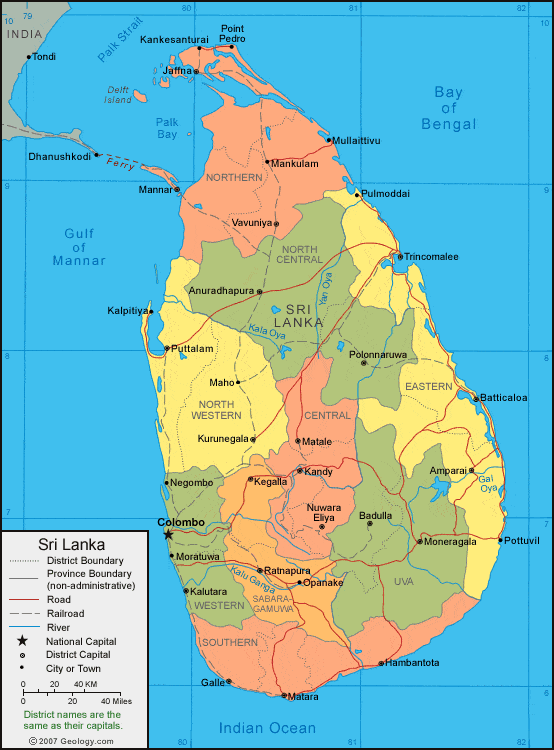
map of srilanka


The Diocese of Trincomalee


The diocese of Trincomalee covers 2,727 square kilometers comprising the civil district. Trincomalee is derived from the Tamil name Thiru-kona-malai, meaning "Holy-East Hill". Hindu civilization flourished here during the reign of the South Indian emperors of the Chola Dynasty. Trincomalee is a port city on the northeastern coast of Sri Lanka, about 257 kilometers northeast of Colombo. The town is built on a peninsula, which divides the inner and outer harbors. Trincomalee diocese is adjacent to Jaffna in the north, Colombo in the west, Galle in the south, Kandy in the central region and Kurunegala. The 2012 census counted 378,182 people in this diocese, whom it identified 14,795 as Catholics. Standard Tamil language is in use. Sinhalese language is used in some areas.
Trincomalee has one of the world's finest natural harbors and can accommodate large vessels. This fact led to Trincomalee being captured in turn by the Portuguese, Dutch, French and British from the 16th to the 19th centuries. It is an important trading city between Sri Lanka and the outside world. Trincomalee lies in the region of Sri Lanka where most of the population is Tamil and Islam by religion. Trincomalee and its environs are sacred to Hindus as well as Buddhists. Tiriyayi, 47 kilometers north of Trincomalee, is a place of Buddhist interest. The ruins of an ancient Buddhist monastery have been discovered here. Ancient ruined temples, beautiful beaches, lagoons, hot springs, vast agricultural lands and tourist hotels can be seen here. The town also has the largest Dutch fortress in Sri Lanka. Trincomalee enjoys warm weather all year round. Trincomalee diocese was one of the places hardest hit by the 2004 tsunami.